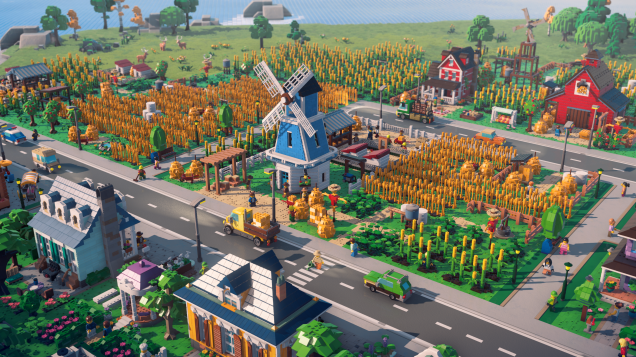
Our hands-on preview of Lego Skylines at Gamescom quickly allayed any fears that Paradox's new city builder would just be Cities Skylines with a fun new skin. It's so much more than a glorified DLC. This is undoubtedly its own game, something shaped from the ground up to be both a solid city-builder from a recognized name and a charming Lego game with all the trademark humor and tactile brick action.
You start by choosing your avatar from a selection of Lego mini figures, making you a tangible character in their world, and you're soon tasked with building a home. Crucially, though, you're not zoning residential areas–you are literally building one home. For a family of real brick-based guys with real needs and wants and desires.
In this case my Lego family wished for a garden gnome to be placed outside their house, which I was easy enough to fulfill. Houses are selected from menus first by size and then by appearance. Each house of the same size is functionally the same, but you can choose if you'd like a sleek, flat-roofed city pad or a rustic farmstead, for example.
A family will eventually move in and the house type will help dictate what kind of environment they want around their house. Decor–which ranges from plaza fountains to big colorful slides or food trucks–can be placed in square panels around houses, reflecting "flavors" like cozy, traditional, or modern.
You're encouraged to choose what the families have asked for to increase your Appeal Level, but there's no fail state if you prioritize aesthetics over practicality. Creating workplaces is crucial to Happiness, taxes, and re. Each house, decor patch, workplace, shop, etc, all also have customization menus, which open up the real granular creativity that fans of Lego are likely to crave.
Every detail is down to you–whether you want to change the color palette of the roof, or the type of flowers on the lawn, maybe you want to install a wood shed, or give them a teeny-tiny garden bench. With every placement, you get the satisfying snap of two Lego pieces threading together, but in the digital world they're far easier to remove.
Blocks can simply be disassembled and tossed into the ether if they don't fit. Workplaces must be built for adult citizens of your slow-growing new town, starting off with farms but expanding into most types of industry and public service. Re. There's nothing to say you have to, though.
In fact, with Lego Skylines that is kind of a recurring theme. Unlike the constant pressure of Cities Skylines, which starts fairly early on and never relents, Lego Skylines builds you up to it slowly, introducing concepts one at a time from re. The emphasis at first is on the player having time to craft something, less so on having increasingly needy individuals immediately run out of bin space (though in the late game, you'll find yourself with those pressures).
Levelling up is gentle, something done when you've built up enough points and you're ready to hit the switch manually. If you wish, you can take your time, drop a few more pieces down, and take on a few side quests first. Humble homesteads soon become impressive cities with plenty of variation.
Because the game can be so zoomed in as to focus on an individual house, the side quests bring you face-to-face with varied Lego minifigs, each with their own personalities. I was asked to build a flower garden for a retiree to enjoy, to hunt down some escaped chickens scattered across the town, and to build an isolated house off in the woods for a lady who liked the idea of off-grid living but didn't seem to have much of a survival instinct.
The dialogue is frequently funny, immediately identifiable as Lego-game-style humor, and each figure having a name and reason for their request makes it feel more like you're roleplaying with real Lego pieces. At present, you can't create your own buildings from scratch; they are all presets.
But being a Paradox game, you just know the modding scene will take off like a feral greyhound and have 20,000 custom builds by the fourth day of release. The gameplay is more like carefully connecting pre-built sets to create something bigger, but it still feels very personal somehow.
It is a proper city simulation in the truest sense, where each minifig has their own job, family, home, and preference for certain leisure activities. You can zoom in and see them walking around, chatting, and shopping, or even admiring the decor you placed just to make them happy.
Leisure facilities like skateparks can be placed around the city, and you'll see them getting used by the citizens. With its slow start and gentle learning curve, Lego Skylines does seem like the perfect introduction to city-builders for kids who might be wanting something more from their toys.
It lets you relax and build the city of your dreams, but it also keeps you buoyant with rewards and a selection of varied challenges for you to work through. In Sandbox Mode, you can modify pretty much anything from tax to biomes, so setting it up as a purely creative virtual playground is definitely viable.
But it isn't strictly a kids game. I'm a fairly seasoned CS player and I still had to get my head around a few of the mechanics with trial and error, ran afoul of my creative desires and forgot to build enough electricity generators, and found some challenges genuinely tough to complete in a way that served everyone's needs.
It's interesting to be shown so clearly that deep simulation and relaxing city-building need not be opposed. Lego Skylines is one of those games that just makes sense, so much so that you have to ask: how did it take this long for a Lego city-builder to be made?